This is the day of Gen-Y: they who have only known unfettered access to ideas via internet and growing steams of communication.
Theirs is a multi-referential pop ideal, as culture ‘eats itself’ like an Ouroboros, constantly regurgitating and re-consuming the bitmapped images they have seen before.
It’s not that there are no new ideas, it’s just that the reconfiguration of old ideas into something new (like a Julian Schnabel “found objects” collage) IS the defining tone of the now.
The litmus test of the times: pop music – and all the promotional imagery that comes with it - has come to reflect the values of pop art more than ever before.
Like a mother bird, regurgitating into the mouths of her squealing young, Lady Gaga is re-feeding us the sounds and images that we may or may not know we’ve grown up with.
Lady Gaga stands for all that is weird and wonderful about the youth of today: she is unconventional, underground affiliated, unashamedly bi-sexual and an grotesque beauty that is far more beguiling than something we might have otherwise asked for.
When the Lady herself drew comparisons to Andy Warhol, many of her detractors scoffed, but lest we forget that the man himself was abhorred by the establishment up until his death: he with his own celebrity magazine and the host of his own TV show live from Studio 54. How could this be a real artist?

 But there is something so very real about the artistry of Lady Gaga. There is a wit and an awareness to her work that makes her seem so much smarter than her predecessors. She seems to transcend the modern day notion of celebrity: never to be seen with a yoga mat under one arm, a Starbucks cup in hand or pumping gas, the girl under the veil, Stephanie Germanotta simply does not exist outside the gilded frame of Lady Gaga.
A bowerbird of contemporary pastiche, Lady Gaga has woven a scrim of pop moments from the last half-century on which to project her vision of art today. She makes associations to inspirations such as David Bowie and Queen, but her references are so vast, the combination, measure and timing of her choices leave us feeling we are watching something utterly now, if not entirely new.
Like Hitler pilfering the swastika from the Hindus and the red banners of ancient Rome, Gaga takes her wig cues from the German transsexual character Hedwig (from Hedwig and the Angey Inch), her maniacal stage presence and a penchant for wearing underwear in public from Grace Jones, and her preference to leave her circular sunglasses on during interviews from John Lennon (or is that Yoko?) The accumulated result is something that is familiar yet intangible.
Her musical sound is a conglomeration of the past also: her song formations seem to reference europop of the 70s and 80s and are more closely resembling Boney M than Britney Spears (even the intro to Pokerface “mum mum mum mah” is the hook out of Boney M’s ‘Ma Baker’) and her predilection to white-chick-rap (“bluffin with my muffin”) takes us from Bondie to Peaches and back again.

In Gaga, we see the culmination of an artist whose skill goes beyond the ability to sing and write successful pop songs. We see the evolution of a performance artist, bringing the underground into the public’s sphere of awareness. For it was in the burlesque scene of Manhattan’s Lower East Side where Gaga crafted her onstage persona. There, she was inspired and tutored by the artist Lady Starlight. Together the duo formed ‘Gaga and the Starlight Revue’ which eventually played at Lollapalooza.
There is a completeness to her work, an overall story being told, which seems to elude so many artists of today. Whereas the usual process of creating a pop album involves purchasing songs from many different writers and brining in as many producers as the record company can afford to invest in, Gaga herself is the source and output of the work. As well as performer, she is the primary writer of both words and melodies and the producer of every track– skills she honed in the years at Interscope Records she spent writing songs for other artists like The Pussycat Dolls.
So quick was she to examine her life under the intensifying spotlight since her star has risen, the resulting meditation was the considerably darker eight new tracks which make up her latest EP, The Fame Monster, ready for release before she had finished promoting her first album, The Fame.

In Gaga, there is the defiance of a mould. This is a girl who has created something that is as culturally valid as it is marketable and engaging – a genius not so readily available, just look at the debris of wannabes past; the scrap heap of one-hit-wonders and pop reality TV ‘winners’.
Tom Ford has said that every decade defines its style in its latter half: when you think of the archetypal imagery of the 60s, 70s and 80s, it is usually made up of ideas that have came to fruition in the second half.
Only in retrospect can we gauge what we have inherited from a period. If the former head of Gucci and YSL is correct, now is the time in which this decade’s legacy will be formed. In Lady Gaga we see an artist who is defining today in a way that wont be fully understood until tomorrow.
Before she was Gaga... Stephanie Germanotta showcases her voice at an NYU event. Barbara Walters interviews, Gaga removes her sunglasses. Duet with Beyonce (included not only because it's a mesmerising video, but because Gaga is almost 'plain clothed') Her best video yet, Paparazzi.
Sam Raimi (director of the Spiderman series and most recently Drag Me To Hell) says that he loves making films for a horror audience because they turn up wanting to be moved. They are willing to, as Stanislavski says ‘suspend their mantle of disbelief’.
“To be moved” is the primary aim of the cinemagoer, regardless of the direction. We watch a motion picture to have a motion within ourselves.
Of the two biggest releases of the past week, one manages to move so entirely, and another fails completely in its task.
Paranormal Activity manages to seemingly transcend the boundaries of what it is possible for us to believe when we watch a film. Knowing full well you are watching something that is scripted and performed by actors, with a continuity person standing next to the director, knowing the catering truck is parked outside, does not quell the overwhelming sensation that you are watching something truly evil and entirely possible unfold before you.
The film is so successful in achieving its goals, and yet it is simply a ‘monster in the house’ supernatural horror that we’ve seen in many incantations before. Yet to convince a cynical modern-day audience that they are experiencing something real goes beyond clever marketing to the essence of any good film: story and performance. Both of these elements are really solid.
The way in which suspense builds to the point that the viewer is begging for the scare, just to release them from the vice-like grip the director holds over his audience is almost Hitchcock-ian.
It is the sort of low budget, seemingly homemade film that can only come along once every few years - just long enough for us to forget the marketing genius that ignited water-cooler discussions the world over almost a decade ago with The Blair Witch Project.
Paranormal Activity was made for US $15,000 and in it’s opening weekend made over $9.1 million in the US making it the most profitable film in history. Where the Wild Things Are, made for close to US$100 million lies at the opposite end of the spectrum in terms of budget and effect.
Spike Jonze has always had an air of ‘skater punk’ about him. Even though his first two films (Being John Malkovich, Adaptation) were deemed praiseworthy by the cantankerous stalwarts of The Academy, he always remained a member of the American-early-naughties-underground through his numerous music and skate videos (most famously ‘Praise You’ by Fatboy Slim and ‘It’s Oh So Quiet’ by Bjork) and his producing Jackass: The Movie.
In WTWTA, there is something about the plight of the misunderstood protagonist, defying the oppressions of ordinance that ring true with what I imagine the filmmaker himself had to endure when fighting for his right to make the film he wanted: a slow and painful birth, where evil Warner Brothers tried to get him to re-staff and re-shoot in light of the delivery of a film that was deemed “too weird” and “too scary” for a youth-targeted general release.
But his damn-the-man attempts fall short, in that – unlike his earlier feature film works that manage to keep one foot in the surreal but still tell a moving story – with this he has created a two-hour music video.
The dour colour palette, the mumbled dialogue as fantasy characters talk out their feelings, the long art-house silences, the indi-as-it-gets melancholic soundtrack by Karen O of the Yeah Yeah Yeah’s. These are all worth fighting for in the face of a studio system that usually demands a colourful result-driven product. But because these elements are not hinged on a story in which a character needs to achieve something, it’s very hard to become emotionally involved. The set up is there, the characters are well established, but from the time he arrives in the land of the wild things the lead character never actually WANTS anything, therefore there is no story.
So by the time Max is saying goodbye the James Gandolfini-voiced best friend creature, Carol, his computer-generated face portraying as much ET-inspired puppy-dog longing as animaters can muster, one can’t help but ponder what’s for dinner.
The unfortunate thing about Where The Wild Things Are is it wont be the commercial or critical success that we had hoped it might be, which might further prevent studios from investing money in films by dudes who where skate shoes with suits to premiers. It will no doubt be the film which wary investors list when bargaining against taking a punt on another maverick in the near future.
Oren Pelli, the unknown director of Paranormal Activity has instantly green-lit his next picture, and rightly so. In terms of ‘time exchanged for emotional experiential value for money’, Paranormal Activity succeeds in every way that Wild Things doesn’t.
Protest, though important as a way of raising awareness, to me wont do enough, as even the most open-minded and accepting of us are still suffering the affects of thousands of years of homophobia engrained in the collective consciousness.
‘Gay Pride’, the banner ideal, is a purely hypothetical notion. So far we have gotten to the stage where we identify homosexuality as ‘acceptable’, that there’s ‘nothing wrong with it’. This unfortunately caps our understanding of it’s importance at the mere point that it should be ‘allowed’. What many don’t understand, even the gays themselves, is that their place in society is crucial.
Even amongst the gay-friendly enclaves of inner-city gen-Y, we are still not convinced it’s more than OK to be gay.
A few years ago, university lecturer friend of mine told me that there is an fundamental scientific difference between the brain of a gay male and the brain of a straight male. It lies in the corpus callosum – the space between the left and right hemispheres of the brain.
The corpus callosum of a gay male brain is wider, meaning that when motor neurons are firing from one side to the other, there is “more room for emotion to get in the way of the decision making”. A straight male’s hemispheres are closer together, meaning their decision making is more “mechanical”.
The brain of a gay male is therefore more closely resembling the brain of the heterosexual female. And for lesbians, their decision making is more “mechanical” rather than “emotive” due to a similarity with the heterosexual male.
I have often reassured recently outed gay guys by sharing this anecdote, so that they should think of them self as super-human rather than handicapped, as they present the greatest strengths of a man in physicality, and the greatest strengths of a woman in mentality.
Unfortunately we are living at the tail end of an era in which civilization has denied the feminine principle. Christianity turned the Pagan celebration of a “Mother Earth” into a “Heavenly Father” and continued to disavow women through witch burnings and the relegation of women to the duties of the home.
Even now, the most homophobic cultures are the ones in which women are seen as secondary to men, the most obvious being Middle Eastern and African.
There is shame associated with boys who are camp or ‘act gay’, when in actual fact they are just acting feminine – a trait which is seen as weak or flawed because somewhere along the way we were taught that being a woman was weak and flawed.
A common ‘bible belt favourite’ argument against the acceptance of gay is that homosexual sex is “unnatural” because it doesn’t eventuate in reproduction.
A theory I’ve encountered suggests that gays are meant to be responsible for giving birth to a different type of sociological function, that of new ideas and ways of thinking.
Without the fundamental drive to procreate getting in the way, the homosexual is liberated to pursue a life dedicated to the creation of thoughts and ideals which beautify and change the world.
There is a reason why the arts are filled with homosexuals - it’s just them enacting the destiny as prescribed to them by creation itself: to be creative, to create life, but in ways in which we haven’t yet known it.
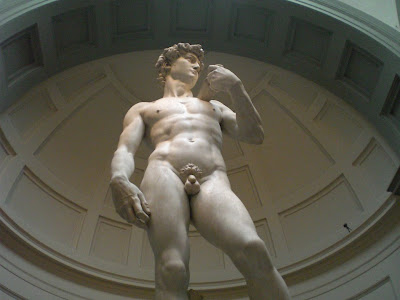
Leonardo DaVinci and Michelangelo are prime examples: both clearly responsible for dramatic leaps in human consciousness, both documented as having relationships and fascinations with men – as seen in the adoration of the male form in their work: sprawling homo-erotic murals that play out like renaissance era Calvin Klein campaigns. Ironically enough, all commissioned by the Church.
There’s a reason why the gay brain is formed as it is: more available to the emotive decision making of art and creation. There’s a reason why homosexuals exist in society, as an antidote, a means to balance the hetero-centric ideal which has reigned for the past twenty centuries, this masculine principal which has left the world in the state it’s currently in.
Today’s rally may eventuate in the acceptance gay civil unions in this country, but until gays learn to harness their strengths and recognise that they have an important role to play in the society’s evolution, rather than begrudge themselves the celebration of their strengths, ‘gay pride’ will be something that exists only in a colourful flag or on a parade route.
We would be better united if we were better as individuals.